Earn Money Online as a Beginner Proofreader
Proofreading is a flexible, online job that will pay well for freshmen who have no experience. The studies found that beginner proofreaders can start to command $15—$25 an hour with freelance possibilities on websites such as Upwork or Fiverr and grow their capabilities through the use of loose task sources. Practice, and you may be able to find entry-level proofreading jobs online that you could do from home, making a constant income.
Getting Started From the Basics:
Focus on developing core abilities like spotting errors in grammar and punctuation. No degree is required, but consistent practice helps. Use free tools to refine your work and create sample projects to attract clients.
Income Potential:
Novices might make $27,000 to $43,000 a year, based on hours and rates. Factors such as niche specialization can drive earnings in the long run.
| Source | Yearly Pay | Hourly Pay |
|---|---|---|
| Bureau of Labor Statistics | $51,100 | $24.57 |
| SalaryExpert | $46,940 | $22.57 |
| Payscale | $50,694 | $20.27 |
| Indeed | $51,608 | $21.77 |
| Zippia | $49,392 | $23.75 |
| ZipRecruiter | $57,520 | $28.00 |
Job Search Tips:
Join a freelance group or two and network with content makers. Begin with smaller jobs to get reviewed and gain some confidence.
Challenges and Considerations:
It’s possible that competition from AI tools could affect demand, but human proofreaders are still necessary for complex content. Come with realistic expectations—it takes time to really build a client base.
For people who appreciate language and exhaustive work, proofreading is a good starting point for freelancing. This thorough manual covers every facet of beginning as a novice, from fundamental concepts to strategic sustainability management. The following sections offer step-by-step insights, helpful advice, and data-driven analysis to help you navigate the field effectively, whether you’re looking for entry-level proofreading jobs or online proofreading work from home.
What Is Proofreading?
(Clear Definition for Featured Snippet)
A final proofread ensures that a written document is polished and prepared for publication or sharing by identifying and fixing surface-level errors like spelling, grammar, punctuation, and formatting (approximately 45 words).
This procedure, which serves as a quality check to identify missed problems, usually takes place after the stages of content creation and editing. For example, a proofreader may correct a repeated word like “the the” or a misplaced comma that automated tools overlook.
The main distinction between editing and proofreading is their scope. Editing entails significant changes that frequently call for rewrites or reorganizations in order to enhance the content’s overall language use, flow, structure, and clarity. Deeper aspects like tone consistency and argument strength are covered. In contrast, proofreading only addresses small corrections without changing the structure or meaning. Editors may recommend removing paragraphs to improve the flow, but proofreaders make sure the final product is free of errors by checking for proper hyphenation or consistent capitalization. Beginners must grasp this distinction because clients may use the terms interchangeably but have specific expectations.
In reality, proofreading necessitates a new viewpoint, frequently involving reading aloud or altering fonts to make mistakes easier to see. It’s crucial in fields where even minor errors can damage credibility, such as publishing, academia, and marketing.
Can You Really Become a Proofreader Without a Degree?
Yes, you can work as a proofreader without a degree because the position values real-world experience and aptitude over formal education.
Proofreaders who demonstrate their abilities through tests or samples, rather than credentials, are valued by clients. For instance, a lot of effective proofreaders begin with a solid command of the language and work their way up, gaining experience through online resources. While not required, credentials such as a bachelor’s degree in journalism or English can be beneficial; instead, concentrate on improving your grammar and attention to detail.
Because proofreading depends on natural talents like accuracy and the capacity to notice inconsistencies, skills exceed degrees. Real-world expectations include knowing Grammarly and style guidelines like the Chicago Manual of Style. Stress transferable experiences like critiquing coworkers’ work or blogging without a degree. Courses from websites such Alison or Proofread Anywhere can help to close gaps and offer certifications that increase legitimacy.
Challenges, however, remain: entry-level positions could call for passing skills exams, and competition is strong. To succeed, volunteer for charities or work on public domain texts to compile a portfolio. With remote prospects, the field is perfect for self-starters and accessible worldwide.
Skills You Must Have to Succeed as a Beginner Proofreader
Certain fundamental abilities are necessary for beginners to flourish in freelance proofreading. Incorporating practical skills for real-world application, these go beyond simple literacy.
- Attention to Detail: It’s essential to notice small mistakes like typographical errors or inconsistent formatting. Often overlooked by novices, this is vital for maintaining customer trust.
- Strong Command of Grammar and Spelling: A thorough grasp of English rules, including punctuation and syntax, is non-negotiable. Dealing with different accents, such as American versus British English, is part of real-world expectations.
- Time Management and Flexibility: Meeting deadlines across multiple projects depends on organization. Entry-level proofreaders must adjust to erratic hours for work-at-home online proofreading.
- Critical Thinking: Consider clarity and consistency without crossing the line into editing.
- Computer Proficiency: Familiarity with word processing, PDFs, and revision history in tools like Microsoft Word is assumed.
- Communication Skills: Communicate effectively with clients about changes, being diplomatic in suggestions.
- Willingness to Learn: Be aware of style guides and industry trends, as clients’ needs may shift.
These skills are aligned with employer demands, where tests are sometimes used to evaluate them directly. Beginners should self-assess through practice exercises to identify weaknesses.
How to Learn Proofreading Skills:
(Beginner Roadmap)
As a beginner, one needs to follow a plan to develop skills without incurring costs.
One can start with free online courses. Alison, an online course provider, has an “An Introduction to Proofreading” course, which covers methods of detecting errors and handling business documents. Similarly, Coursera has modules on writing and editing, including peer-review assignments. Also, there are many videos on YouTube, such as those by Proofread Anywhere, that provide information on common mistakes.
Methods of practicing proofreading include proofreading books from Project Gutenberg, which are free, or working for free on websites such as LibriVox. One can also try their hand at creating before-and-after examples by editing texts from blogs or news articles.
Self-evaluation of one’s proofreading skills can be done by comparing one’s work with professional standards. For this, one can use checklists to evaluate grammar, punctuation, and formatting. Also, one can ask for feedback on forums such as the proofreading community on Reddit.
Knowledge of style guides is also necessary. For this, one can read free excerpts of the Chicago Manual of Style or the AP Stylebook. Also, one can try their hand at applying the rules to different types of texts, such as academic or marketing texts.
This process would take 1-3 months, after which one would be confident of applying for proofreading jobs online.
Essential Proofreading Tools for Beginners:
Proofreading tools for newbies make the process easier and more efficient, with no high costs.
Some free proofreading tools include Grammarly, which proofreads for grammar, spelling, and clarity. It also proofreads in real time. Google Docs offers suggestions and remote working features. Hemingway Editor also proofreads for complicated sentences and uses of passive voice.
Some proofreading tools that cost money (not necessary but can be used) include ProWritingAid, which offers detailed reports on style and overused words. It costs $10/month. Antidote offers advanced features, including proofreading of several languages, which is important for clients from other countries. It costs a one-time payment of $130.
| Tools | Type | Key Features | Cost |
|---|---|---|---|
| Grammarly | Free/Paid | Grammar, spelling, tone suggestions | Free basic; $12/month premium |
| Google Docs | Free | Real-time editing, comments | Free |
| Hemingway App | Free | Readability analysis | Free |
| ProWritingAid | Paid | Style reports, integrations | $10/month |
| Antidote | Paid | Multilingual checks | $130 one-time |
Where to Find Legit Beginner Proofreading Jobs Online:
Getting legitimate beginner proofreading jobs online begins with the right job platforms and networking.
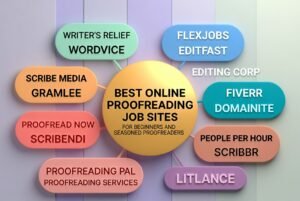
Upwork and Fiverr online job platforms have a section for beginner proofreading jobs. You can bid for jobs like blog posts or ebooks.
FlexJobs is a job platform that lists online proofreading jobs. It also filters jobs for those who have no experience.
ProofreadingServices.com is a job platform that hires globally after a skills test. It also lists part-time proofreading jobs.
For direct clients, send a portfolio of work to publishers or agencies.
For more practice, use Clickworker.
Content creators and bloggers on Medium or LinkedIn need proofreaders. These people need proofreading services at affordable rates. Join Facebook groups or Reddit groups and offer proofreading services.
Scams can happen online. To avoid these, look for job platforms on the Better Business Bureau website. Never pay before getting the job.
How to Build a Proofreading Portfolio:
Demonstrating a portfolio also shows potential even in the absence of remuneration.
Start with sample work. You can proofread public domain works such as Wikipedia articles or ebooks, creating before-and-after versions.
Mock work can also be used. You can edit fictional blog posts or resumes, explaining what changes you made.
Ethical ways of getting experience include volunteering at non-profit organizations through VolunteerMatch or providing services to friends in exchange for testimonials
| Project Type | Description | Skills Demonstrated |
|---|---|---|
| Blog Post | Edited a 500-word article | Grammar, flow |
| Resume | Corrected formatting errors | Punctuation, consistency |
| Ebook Excerpt | Fixed spelling in the chapter | Attention to detail |
This approach builds credibility for freelance proofreading for beginners.
How Much Money Can a Beginner Proofreader Make?
Newbie proofreaders can realistically make $15-$25 per hour, which equates to $27,000-$43,000 per year if they work full-time.
If we compare this with the earnings of experienced proofreaders, who make an average of $50,000-$70,000 per year, the earnings of beginners are lower because they are still developing their clientele.
| Level | Hourly Rate | Annual Estimate | Factors |
|---|---|---|---|
| Beginner | $15–$25 | $27k–$43k | Entry gigs, general niches |
| Experienced | $30–$50 | $50k–$70k | Specialization, repeat clients |
Earnings grow with reviews and rate increases.
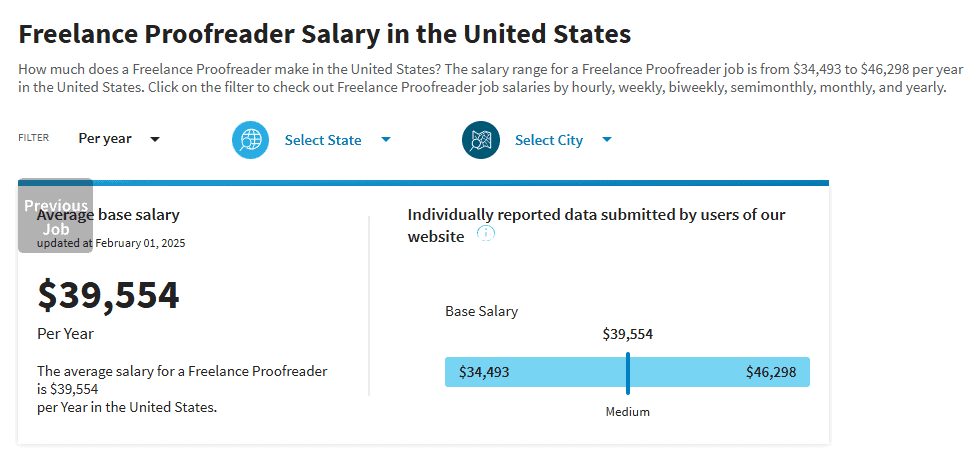
Salary.com Data from February 2025
How to Get Your First Proofreading Client
(Step-by-Step)
- Create profiles on Upwork and Fiverr.
- Emphasize skills and provide samples.
- Look for beginner jobs and tailor the proposal to the client’s needs (e.g., “I will make sure that the content is error-free”).
- Charge competitive rates for the job, e.g., $0.01 to $0.02 per word.
- Send a follow-up after 3–5 days politely.
- Provide quality work and ask for a review for future use.
Common Beginner Mistakes That Limit Earnings
1. Overworking leads to burnout and errors, causing client loss. Set boundaries around your schedule.
2. Undervaluing your services by undercharging perpetuates low pay; research rates and adjust after initial jobs.
3 . Lack of specialization puts you in the general low-pay market; focus on a niche, such as academics, for higher rates.
4 . Using only spellcheck lacks context; always review by hand.
5 . Not marketing means you’ll never gain clients; network regularly.
Frequently Asked Questions (FAQs)

Is Proofreading a Good Long-Term Online Career?
The proofreading career scales well, allowing a freelancer to develop a business by hiring subcontractors or creating courses.
Skill growth involves advancing to editing or specializing in areas such as medical texts, which are in high demand and allow for higher rates.
The realistic outlook is positive, and despite the impact of technology like AI, the demand for human involvement remains steady. Global remote work supports career longevity.
Do proofreaders need certification?
No, you really don’t. Plenty of developers enter without a certificate. It can look good when you’re new, sure. Derp: Oh!This.fucking.thing.insert_title I mean, here’s the thing–clients pretty much only give a shit about one thing: can you actually catch errors? If you can prove you’re good at it, that’s all that matters.
How long until you get your first client?
It usually takes some time. For the vast majority of beginners, it’s more like one to three months.” At the outset, you are likely to submit dozens of applications and receive no reply. That part can feel frustrating. Totally normal though. You keep going, you stay consistent and eventually someone says yes.
Does proofreading still need humans?
Yes, it does. Every day, humans are writing and publishing blogs, books, business documents, etc. And grammar mistakes haven’t just vanished overnight. They happen, especially when businesses rely on AI tools – but errors can slip through the cracks. So yes, proofreaders are still necessary. Those extra eyes help.
Can you proofread as a part-time job?
Yes, you certainly can. One thing I love about proofreading as a job is that you can start part-time. You never have to quit your day job or go back to school. You can work as little as 10–20 hours per week if you want. Nights and weekends are okay too!
What niches should beginners start with?
When first starting, I recommend sticking to blog posts and simple ebooks. The content will be easier to manage, and you’ll feel more confident in your abilities. You can graduate to proofreading academic or marketing copy down the road if you desire higher rates. But when starting out? Simple works best.



One Comment on “How to Earn Money Online as a Beginner Proofreader Without a Degree”