
Introduction
If you don’t wanna be like everyone else, then you have to make the sacrifices others aren’t willing to make.
That’s what my mentor told me when I was in my early 20s and it stuck with me ever since.
I started out with no qualifications and no money, but still managed to become a multimillionaire, and a big part of that was down to avoiding the seven things I’m gonna be sharing with you today.
1. Working for JUST Money
The first thing to avoid is working for only money.
Path A vs. Path B: The Critical Choice
Imagine for a moment that you got a boring but well-paid job. You quickly start stacking some nice cash as your earnings grow. Your friends will think that you’re absolutely killing it and your parents will probably be pretty proud too. However, over time, your earning potential would start to plateau. This is path A.
Now, imagine instead you get a challenging but lower-paid job. You might struggle for a couple of years as you improve and adapt. You may even struggle to pay the bills. Your friends will probably think you’re falling behind and your parents may not agree with the path you’ve taken. However, over time, your earning potential will start going through the roof. This is path B.
So, what’s the difference between these two examples? Well, path A prioritizes money early on, whereas path B prioritizes two key things: skills and equity.
Every self-made millionaire I know has followed path B as it’s the only way to build that kind of wealth.
My Personal Story: Choosing Skills Over Money
As I mentioned, I left school at 16 with no qualifications. However, I immediately went out looking for jobs and actually got offered more than five opportunities. So, I had a big decision to make. Which should I choose?
I decided to become a carpenter’s apprentice. The pay wasn’t great, but I knew the skills I’d learn would be extremely valuable, so, I prioritized those. There was no way I was gonna get equity in the business, but at least I was working for more than just money.
That job taught me a lot, and although I was forced to quit after being relentlessly bullied by my manager, I still use many of those skills today when I’m designing my bestselling brand of radio-controlled planes that I sell across the world.
Become Your Greatest Asset
By learning a wide range of high-income skills, it makes it almost impossible for you to ever be broke again as you become your greatest asset.
I like to think every job I had when I was younger added to my skillset like a Swiss Army knife. Nowadays, I’d recommend prioritizing online-based high-income skills such as copywriting, video editing, and coding. The demand for these skills is only growing, and I can speak from experience that there is a huge skill shortage at the moment.
Sure, there are lots of people doing those things, however, 99% of them are just not up to standard. Honestly, your competition really isn’t that tough.
Understanding Equity
Now, let’s move on to the second thing, equity. This just means owning a percentage of a business so you can benefit from the profits. My radio-controlled model brand is a perfect example of this.
You can gain equity in a few different ways. The most obvious way, and the way I did it, was to start the business myself. However, you can also gain it by working for it if you’re extremely skilled in certain areas. This is known as sweat equity. Lastly, you can purchase equity in certain businesses, although, I wouldn’t recommend this as much unless you have the skills that can help accelerate that business forward.
Be Realistic About Equity
My friend Simon Squibb often goes around in public telling people to start their own businesses or ask for equity from their boss. While I 100% agree with the sentiment, you need to have some self-awareness with this.
Firstly, it’s worthwhile working for someone to gain skills before starting a business of your own. Secondly, you need to be realistic. I didn’t think for a moment that I’d get equity in the carpentry business when I was an apprentice. So, when you ask, make sure you have a solid case for why you deserve it and how you can add value to the business instead of just taking from it.
You need to first focus on becoming someone worthy of equity.
The main takeaway here is that too many people get blinded by money, forgetting the importance of skills and equity. This is the biggest trap. The more you obsess over earning just money, the less you’ll likely make in the long run.
2. Buying a Lifestyle
The second thing to avoid is buying a luxury lifestyle.
The Dubai Illusion
Picture yourself cruising through Dubai, sun-drenched streets in a bright yellow Lamborghini. You pull up to a swanky restaurant and order a $500 fillet steak without batting an eyelid. How does imagining that lifestyle make you feel? Pretty successful, right?
Well, here’s the truth. Most people you see living this way are far from successful. The majority are paying for cars that they can’t afford, taking trips to Dubai on credit cards they’ll spend five months paying off, and ordering steaks at Salt Bae’s restaurant that leave them with a bill they can’t handle.
These people are living a lie, pretending to be rich while drowning in debt. It’s all smoke and mirrors, as it’s much easier to impress others on social media than build real wealth.
The Harsh Reality
Seeing people live these luxury lifestyles might tempt you to start playing the flexing game too, as you feel like everyone is living a better life than you. However, this is far from the reality.
In fact, 37% of Americans can’t afford unexpected expenses over $400, 39% worry they can’t pay their bills, and 60% of American households can’t afford to buy a new car.
Build Wealth First, Flex Later
Once you’ve made your millions, you can buy whatever you want. That’s the point of becoming wealthy. However, in the early days, you can’t live like a king and build wealth at the same time.
Instead of buying depreciating items like flashy cars, designer clothes, and dining in expensive restaurants, invest in assets, such as stocks, shares, crypto, and real estate. These assets will increase in value and generate income that you can then use to do whatever you want.
3. Doing Everything Yourself
The third thing to avoid is doing everything yourself.
You might be really great at what you do, but no matter how hard you try, you’ll never be able to outcompete a group of talented people working together.
The PayPal Mafia Example
Look at anyone who’s made it big in sports or business. If you do some digging, you’ll see they all had help. Let’s take Elon Musk as an example.
On the surface, it might appear like he’s a genius entrepreneur who’s achieved everything single-handedly. However, that couldn’t be further from the truth. He was part of the group that launched PayPal. When eBay acquired PayPal for $1.5 billion in 2002, these newly-wealthy tech experts spread across the industry like a virus.
Now they’re known as the PayPal Mafia, as they’ve become such a powerful group. After leaving PayPal, they started many successful companies. These include big names like YouTube, Yelp, LinkedIn, and SpaceX. They often invest in each other’s projects and give advice.
The Opportunity for You
But what if you’re not aiming to launch the next billion-dollar company and instead just want to earn some extra money with a side hustle?
Well, a lot of older business owners are kind of lost when it comes to everything tech-based and using the internet for their companies. I mean, a lot of them don’t even know there’s online tools for literally everything, whether it’s managing your team, handling invoices, keeping track of projects, or even building a website.
I don’t blame them as back in the day, we didn’t have any of these things, but now the younger generation has a real advantage. So, if these older business owners don’t know how to do a lot of this online stuff and they understand they can’t do everything themselves, guess who they need? You.
You can help them bring their businesses into the 21st century and make a lot of money in the process.
4. Having Too Many Inputs
The fourth thing to avoid is having too many inputs.
The Cognitive Overload Problem
Do you ever feel like you’re being pulled in a million different directions? This happens with everything in life, from side hustles to fitness training. Everyone seems to have a different opinion on what you should be focusing on.
All these inputs create hundreds of paths you could follow, like becoming a doctor, entrepreneur, joining a family business, getting a stable nine-to-five job, traveling, and having a family. Let’s call these your potential paths.
The sheer number of these pathways can create something called cognitive overload, which is where your brain simply can’t cope with the overwhelming amount of information and choices.
The Solution: Work Backwards
So, what’s the solution? Well, I’ve always started with my end destination in mind and worked backwards. Of course, I didn’t know exactly what I wanted to do in the future. However, I had a decent idea.
I then made sure to only listen to inputs that help me reach those targets. The clearer your goal, the easier it becomes to select the right inputs to help you achieve it.
Quality Over Quantity
So, limit the number of opinions you receive and prioritize quality over quantity. Most people have too many opinions being thrown at them, but not from experts.
Cut out general opinions and instead seek expert advice. This could come from a mentor, someone successful in your field, or even educational content from experts like myself. By doing this, you’ll get more valuable, focused, and specific guidance for your end goal.
Avoid Decision Paralysis
Remember, even when you work your way backwards, you still don’t need to know everything at once. Fully listen and implement what you learn from an input, and then when you’re facing another challenge, you can seek out more inputs that’ll help you overcome it.
If you don’t do this, then you’ll get mental fatigue, which can lead to decision paralysis where you find yourself unable to take action or move forward. Some people might even mistake this for being lazy, but in reality, your brain just gets overwhelmed.
5. Being Ego Driven
The fifth thing to avoid is being ego driven.
The Arrogance Trap
Let me start by saying this, arrogant people won’t even finish this article. They think they already know everything, so, why bother sticking around? But that’s exactly the problem. Arrogance blinds you to the opportunities that could genuinely change your life.
Ego-driven people are often too focused on the big picture, constantly dreaming of the end goal. This might sound productive, but it’s a dangerous trap. When you’re always looking too far ahead, you end up overlooking the small but crucial steps that lead to true success.
Missing the Small Steps
For example, some might be tempted to scroll through this article just to see all seven things rather than sitting down and actually absorbing the knowledge in each one, but by doing so, they miss out on the valuable insights that could fast-track their journey.
When you’re too egotistical, you start to believe that you don’t need advice from others, especially those who might know more than you. You might dismiss the wisdom of people who have already walked the path that you’re trying to take.
The Iceberg Principle
But here’s the truth. True wealth isn’t just about being confident. It’s about having the humility to keep learning, to understand that you don’t know it all, and that’s where the real growth happens.
The more you learn, the more you realize how much you don’t know. This is called the iceberg principle. What you know is just the tip of the iceberg. The massive chunk of knowledge is underneath the surface. That’s what truly matters, and arrogance makes you forget that it’s even there.
In short, arrogance is a silent wealth killer. It convinces you that you’re too good to learn, too smart to listen, and too important to take the small steps that lead to greatness.
6. Passing the Blame
The sixth thing to avoid is passing the blame.
The Chinese Proverb
One of my favorite Chinese proverbs is: the man who blames others has a long way on his journey to go. The man who blames himself is halfway there. The man who blames no one has already arrived.
The Magnifying Glass vs. The Mirror
In life, you’re gonna have to choose to reach for either of these on a daily basis: a magnifying glass or a mirror.
If you choose to pick up the magnifying glass, it gives you the ability to hyper-focus on other people. This is a dangerous path as it leads to the blame game.
Look, I do kind of get it. When anything goes wrong in life, it’s natural to wanna pass the blame onto someone else, anyone but yourself. I’m sure there’s been times when you’ve blamed your teacher for a test you failed, even though you spent more time binge-watching Netflix than actually studying, or maybe you passed the blame onto the traffic for being late, even though you left the house 10 minutes later than you should have.
How Small Excuses Become Big Ones
But here’s the thing, these small instances of blame don’t stay small. Over time, they grow into a habit that’s hard to break free from.
I’m sure you’ve seen people say stuff like:
- “The government hates young people”
- “The system is rigged against people like me”
- “My boss doesn’t like me”
- “I’m not rich enough to start a business”
- “Life didn’t give me the right opportunities”
The more you reach for the magnifying glass, the bigger your excuses become.
Choose the Mirror
However, if you pick the mirror, then you instead focus on the stuff you can actually control: your own thoughts and actions.
So, to embody the wisdom of the Chinese proverb, to be the person who has already arrived at their destination, you need to pick up the mirror, not the magnifying glass.
7. Staying Static
The seventh thing to avoid is staying static.
The Comfort Zone Prison
Your comfort zone is where you retreat seeking safety and security. Notice how there are no gaps in this circle. Almost like a self-imposed prison with no way out and no way to grow.
If you’re currently here, then you’re not alone. According to some studies, over half of Brits don’t leave their comfort zone, and 45% of them are worried that one day they might regret it.
How I Expanded My Comfort Zone
So, what can you do to break out of this prison? Well, you need to expand the circle. This can be really difficult when our minds are conditioned to avoid taking risks, but it’s something I learned at an early age. Let me show you how I did it.
Step 1: Leaving School When I was younger, my comfort zone was narrow: school, studying subjects I wasn’t good at, like maths and English. The traditional education system didn’t suit me. I didn’t wanna be a banker, doctor, or lawyer. I wanted something more hands-on. So, I stepped out of my comfort zone and pursued the apprenticeship I mentioned earlier. This created a new space for me.
Step 2: Side Hustles But I wasn’t satisfied yet. I knew I needed more from life, so I started experimenting with side hustles, which pushed me further into unfamiliar territory. Suddenly, the world was full of possibilities.
Step 3: Starting My Own Business The next step was clear, starting my own business. This was a pivotal moment requiring a big risk, a bank loan. It was the best decision that I ever made.
Step 4: Traveling to China To expand my empire further, I traveled to China in search of a manufacturer for my own brand of radio-controlled models. Despite the language and cultural barriers, I managed to build valuable connections.
Step 5: Starting YouTube I ran my business for many years and enjoyed success, but eventually I felt complacent. My family was happy, my bank was happy, but my mind wasn’t. I wanted more. So, I expanded my comfort zone again and started posting content at the age of 53.
I’d seen so many people faking it, so I wanted to share my knowledge and help others who, like me, didn’t fit the traditional path or those who wanted to grow their wealth and feel more secure in life.
Claim Your Infinite Space
Remember, you can expand your comfort zone as much as you want. This space is infinite. But you have to claim it for yourself. If you don’t push beyond your current boundaries, you’ll miss out on all the possibilities that could have been yours.
Conclusion
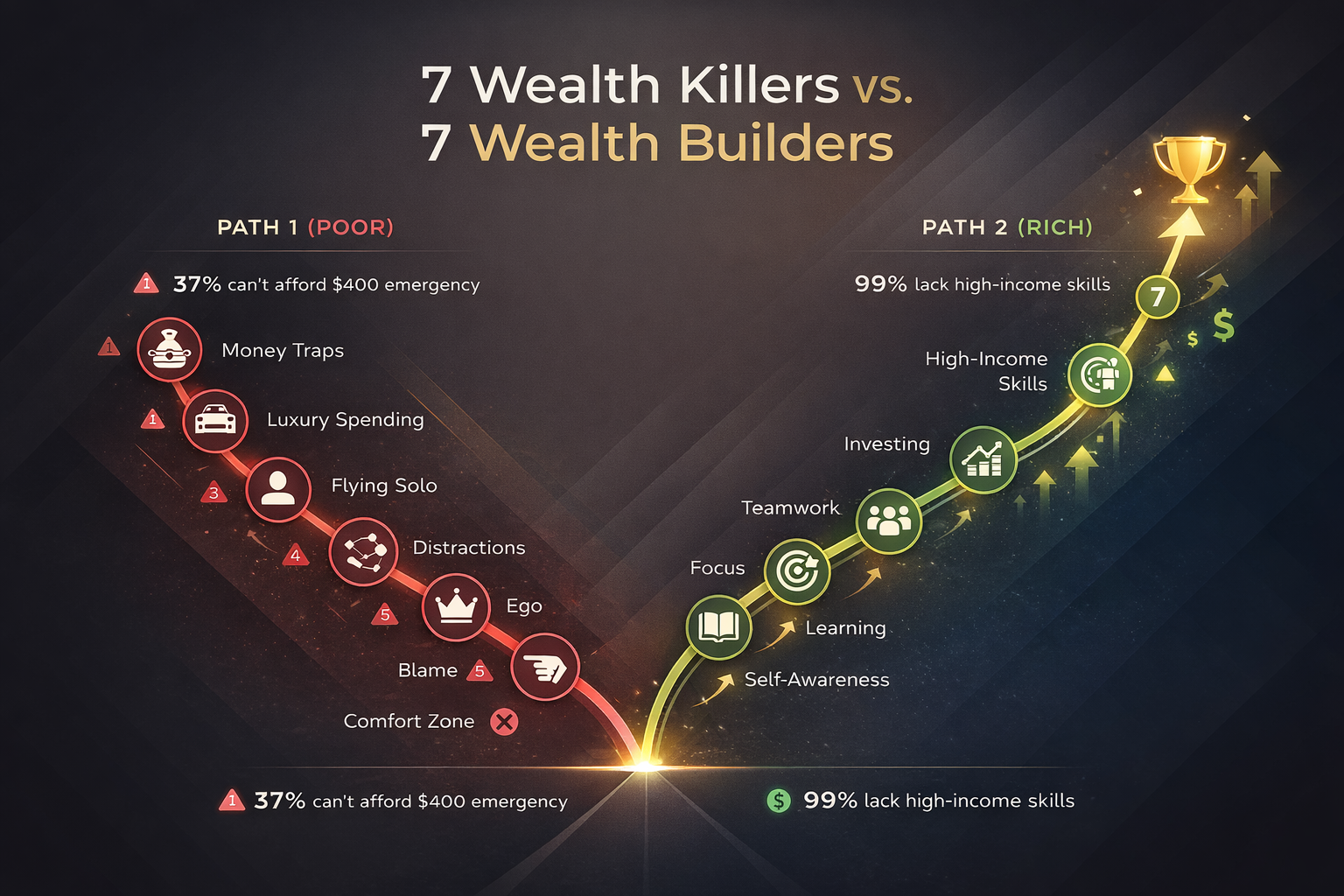
These seven wealth killers are what separate the rich from the poor. Avoid working for just money, buying a lifestyle you can’t afford, doing everything yourself, having too many inputs, being ego driven, passing the blame, and staying static in your comfort zone.
Each of these traps will keep you stuck in mediocrity while others race ahead. But now that you know what to avoid, you have the knowledge to make different choices. The question is: will you take action?